%20(300%20x%20300%20px).png)
The Hundred: Why Scoring Has Stalled in England’s 100-Ball Revolution
Updated: Nov 8, 2025
By MatchMind Analytics Team
Setting the Scene
When The Hundred launched in 2021, it promised to redefine limited-overs cricket — a faster, sharper, entertainment-driven format designed for a new audience. But beneath the fireworks, the analytics reveal a fascinating question: Has the 100-ball format really changed the scoring landscape?
At MatchMind, we analysed five full seasons of T20 data (2021–2025), reviewing every completed first innings to uncover how teams adapt over time. These insights feed directly into our cricket betting models, enhancing accuracy in cricket prediction markets. The patterns we uncovered might surprise you.
The Numbers: A Five-Year Overview
Across all five seasons of The Hundred, the average first-innings total sits at 144.9 runs, with teams scoring an average of 1.416 runs per ball.
Here’s how those figures break down season by season:
Season | Avg. 1st Innings Total | Avg. Runs per Ball |
2021 | 144.3 | 1.426 |
2022 | 150.9 | 1.448 |
2023 | 153.5 | 1.526 |
2024 | 129.8 | 1.287 |
2025 | 146.0 | 1.398 |
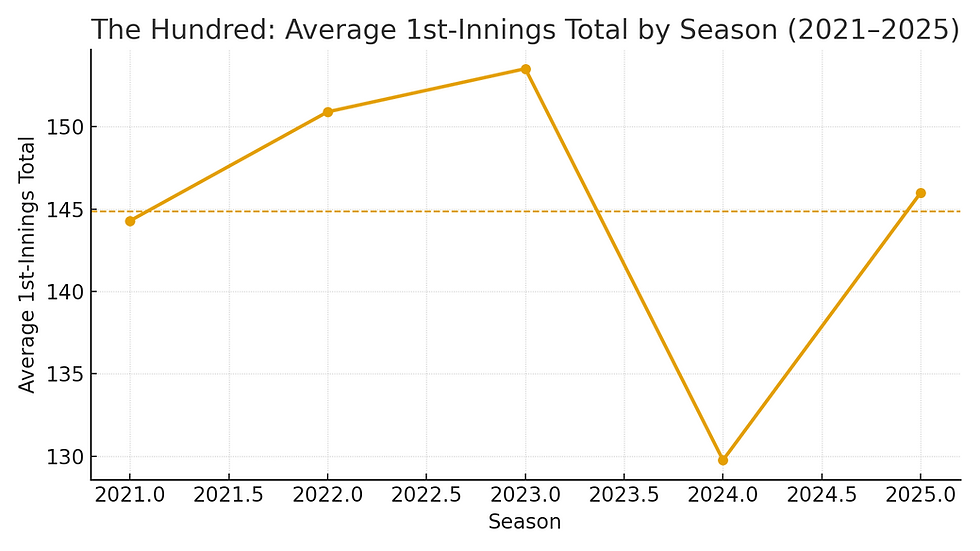
The Rise, Fall, and Plateau
After two years of steady growth, scoring in The Hundred peaked in 2023.That season saw teams averaging over 153 runs per innings and 1.53 runs per ball — a high watermark that suggested batting sides had finally mastered the 100-ball rhythm.
Then came the correction.
The 2024 season marked the steepest decline in the competition’s short history — down nearly 20 runs per innings and 0.24 runs per ball from the previous year. Although there was a modest recovery in 2025, totals have yet to return to their mid-2020s highs.
So, what changed?
Why Have Scores Dropped?
Our model points to a combination of tactical and environmental factors:
1. Pitches and Scheduling
The Hundred runs deep into the English summer, often on used pitches after county or international fixtures. By 2024, several venues displayed slower surfaces and variable bounce — perfect conditions for cutters, slower balls, and spin containment.
2. Bowling Intelligence
Teams have become data-aware. Bowlers are now attacking specific matchups, particularly using pace-off bowling in the middle overs. The rise of short, targeted spells — where bowlers only deliver 10 balls in total — has allowed for more focused execution without fatigue.
3. PowerPlay Restraint
Early evidence (which we’ll unpack in tomorrow’s article) shows that teams are taking fewer risks during the first 25 balls. The PowerPlay, once a license to swing freely, has been redefined by smarter field settings and early wicket pressure.
Comparing to T20: A Familiar Pattern
If we normalize The Hundred’s scoring rates to a T20 equivalent (120 balls), the math is striking.A run rate of 1.416 per ball converts to roughly 170 runs per innings — putting The Hundred right in line with T20 averages globally.
In fact, over the same 2020–2025 period, the Indian Premier League (IPL) recorded an average first-innings total of 171 runs, rising steadily over the last three seasons:
2023: 176 runs
2024: 181 runs
2025: 184 runs
So while the IPL has become progressively more batting-friendly, The Hundred appears to be moving the other way — stabilizing around the mid-140s.
That stability isn’t necessarily a flaw. It may indicate that bowlers have adapted faster in England’s shorter format, learning to exploit its compressed structure and limited recovery opportunities.
Translating the Analytics: 100 Balls ≠ 120 Balls
The 100-ball format isn’t simply a “shorter T20.”Teams face unique constraints:
Fewer overs (20 vs. 16.4) means less time to rebuild after wickets.
Changing ends only every 10 balls alters rhythm and strategy.
Captains have to manage bowlers in 5-ball bursts, making match-ups even more tactical.
These subtle shifts ripple through scoring patterns — affecting everything from strike rates to boundary frequency.
What This Means Going Forward
The Hundred’s scoring trends tell a story of adaptation and equilibrium. After an experimental surge in early seasons, both batters and bowlers now seem to have found their tactical balance. Whether the format tilts back toward batters will depend on innovations in PowerPlay aggression, batting depth, and data-driven matchups — areas we’ll explore next.
Coming Up Next: PowerPlay Analysis ⚡
Tomorrow, we’ll dig into how PowerPlay scoring rates have evolved across The Hundred — and whether early aggression still pays off in a 100-ball world.
We’ll also examine whether teams are leaving too much value on the table by starting conservatively.
Collect. Build. Predict. Recommend. Update. Bet. Explore how our predictive analytics are powering smarter decisions in cricket betting and performance strategy at matchmind.tech.


Comments