%20(300%20x%20300%20px).png)
A gentle introduction to “smarter” bets
You don’t need to be a statistician, data guru, or numerical savant to make well-informed and sensible bets. In this article, we'll outline an approach to betting that leverages your personal beliefs and market analysis to optimise your decisions on “kitty allocation”.

Before we delve into the “how,” let's first define the problem and establish some key terms.
1. The Problem
We'll focus on the “Season Winner” (Outright Winner) betting market for the 2024 Caribbean Premier League T20. This type of bet, known as a future market, involves predicting which team will win the season. The outcome of this bet is only realised once the season concludes. For this article, we assume that the bet is placed right at the start of the season, before any games have been played. This timing allows you to take advantage of the highest odds, largest variance, and minimal information about team and player performance.
2. Key Definitions
Betting Markets: These refer to the various types of wagers that can be placed on different outcomes within a sporting event. In cricket, betting markets offer a range of options for bettors to predict various aspects of the game, beyond just the result. Here are some common betting markets in cricket:
Match Winner: Bet on the team that will win a specific match (also known as Head-to-Head).
Season Winner: Bet on the team that will win the season (i.e., which team will clinch the season title).
Odds: Odds represent the likelihood of a particular outcome in a sporting event, as well as the potential payout a bettor can receive if they place a bet on that outcome. They determine both the risk and reward involved in placing a wager.
Example in Cricket:
Team A: $1.50 and Team B: $2.75
If you bet $100 on Team A at odds of $1.50, you would receive $150 ($100 x 1.50), which includes your original stake. Your winnings in this example would be $50 ($150 - $100).
If you bet $100 on Team B at odds of $2.75, you would receive $275 ($100 x 2.75). Your winnings in this example would be $175 ($275 - $100).
Implied Probability: The odds offered by a betting agency can be converted into an implied probability, representing the chance of the event occurring. In the example above, Team A has an implied probability of 66.7% (1/1.5), while Team B has an implied probability of 36%. Note that these probabilities add up to ~103%, which is why a bookmaker’s probabilities don’t sum to 100%.
Variance: In betting, variance refers to the uncertainty (or risk) associated with an event occurring (e.g., Team A winning). In the example above, Team A has a lower variance compared to Team B, indicating less risk and thus lower returns. Conversely, betting on the underdog offers a higher potential reward due to the greater variance in their performance, meaning a higher chance of losing. Variance is highest at the beginning of the season when little is known about team dynamics, making the odds more favourable.
Information: This term typically refers to the amount of data available on teams, players, chemistry, etc. Information and variance are inversely related: as information increases, variance (uncertainty) decreases, leading to less favourable odds. At the start of a season, information is minimal, making the odds more attractive. As the season progresses, information grows, and odds become less appealing.
Now that we've defined our problem and key terms, we can delve into the "how." The remainder of the article is divided into five sections:
1. CPL Overview
2. Your Belief System
3. What Does the Market Say?
4. Formalise Your Knowledge
5. Hedging Your Bets
3. Caribbean Premier League Overview
In this section, we’ll provide some basic statistics about the Caribbean Premier League (CPL) that we gathered from a simple search on ESPNcricinfo:
League Establishment: The CPL is a T20 league that was established in 2013.
2024 Season: The 2024 season will feature six teams:
St Lucia Kings (SLK)
Guyana Amazon Warriors (GAW)
Trinbago Knight Riders (TKR)
Barbados Royals (BR)
Antigua and Barbuda Falcons (ABF)
St Kitts & Nevis Patriots (STKNP)
Each team will play 10 games.
Home Advantage: Since 2018, the home advantage in the CPL has been around 58%, meaning that 58% of the time, the home team wins the game.
Note: We selected 2018 as our starting point because the league and its rules have undergone significant changes since its inception. By focusing on data from 2018 onwards, we aim to avoid skewing our analysis with outdated information while also mitigating “recency bias” that could arise from only considering data from 2022 and 2023.
Home Advantage by Team: Breaking down the home advantage by team, we find that:
TKR and GAW are the most successful teams in terms of home advantage, with a home win rate of 62%.
JT, no longer in the league, had a home win rate of 56%.
BR, SLK, and STKNP follow closely behind.
Titles and Finals Appearances (Since 2018):
Trinbago Knight Riders (TKR): 1 title (2018) and 2 finals appearances.
Guyana Amazon Warriors (GAW): 1 title (2023) and 3 finals appearances.
Other Teams: Except for St Lucia Kings (SLK), all teams have won at least one title.
Expected Wins Based on Home Advantage: Given the significant impact of home advantage, it’s important to understand how many home games each team will play in total. From there, we can calculate their “Expected home Wins.” For example, if a team plays 10 home games with a 58% home win rate, their expected number of home wins would be 6 (10 games x 0.58).
Team | Total games | Home Games | Home advantage | Exp. Home wins |
GAW | 10 | 5 | 0.62 | 3 |
BR | 10 | 5 | 0.55 | 2.75 |
SLK | 10 | 5 | 0.43 | 2.15 |
TKR | 10 | 5 | 0.65 | 3.25 |
SKTNP | 10 | 5 | 0.33 | 1.65 |
ABF | 10 | 5 | N/A |
|
We don’t have a home advantage for ABF as they haven’t played in the league since 2014 – We don’t want to use the 2014 data as it’s outdated from a player & franchise point of view
4. Your Belief System
Using the information we’ve gathered (all publicly available and requiring no complex number crunching), we can begin to form a belief system about which teams are likely to clinch the title. One approach is to start with a process of elimination. For instance, Antigua and Barbuda Falcons (ABF) are a new franchise this season, returning after a decade following the sale of the Jamaica Tallawahs. Given this, it’s reasonable to assume that ABF may be less likely to win the title as they work to establish themselves.
Remaining Teams: This leaves us with five teams to consider: Guyana Amazon Warriors (GAW), Barbados Royals (BR), St Lucia Kings (SLK), Trinbago Knight Riders (TKR), and St Kitts & Nevis Patriots (STKNP).
Next, we want to narrow down our selection by eliminating one or two more teams. Based on the CPL data, GAW and TKR have been the most successful, followed closely by BR. As a result, we should consider placing a portion of our bet on GAW, TKR, and BR. Additionally, we might include SKTNP in our considerations.
Based on this analysis, we assign probabilities to each team winning the title. These probabilities should add up to 1 (i.e 100%) and based your “belief system” using the analysis:
Trinbago Knight Riders (TKR): 0.24
Guyana Amazon Warriors (GAW): 0.23
Barbados Royals (BR): 0.18
St Kitts & Nevis Patriots (SKTNP): 0.14
St Lucia Kings (SLK): 0.13
Antigua and Barbuda Falcons (ABF): 0.08
5. What Does the Market Say?
To understand the market’s perspective, we’ll look at information from a betting agency. Essentially, we want to compare our belief system with what the market says, as reflected in the odds offered. These odds can be transformed into “implied probabilities” (as explained in the definitions above).
By comparing our assigned probabilities with the implied probabilities from the TAB, we gain insight into how our beliefs align with the broader public’s expectations:
Trinbago Knight Riders: $4.50 (0.22 implied probability)
Guyana Amazon Warriors: $5.00 (0.20 implied probability)
Barbados Royals: $5.50 (0.18 implied probability)
Saint Lucia Kings: $6.50 (0.15 implied probability)
Antigua and Barbuda Falcons: $8.00 (0.125 implied probability)
St. Kitts & Nevis Patriots: $10.00 (0.10 implied probability)
6. Formalise your knowledge into a problem
Now based on our belief and what the market says we want to formalise and optimise how we allocate our kitty based on the two set of probabilities using something called the “Kelly Criterion”. The Kelly Criterion - is a formula used to determine the optimal size of a series of bets or investments to maximise long-term growth of wealth. It considers the probability of winning, the odds offered, and the proportion of your bankroll that should be wagered to maximize your potential returns while minimising the risk of losing your entire bankroll. Below is the equation:
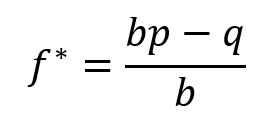
Where:
f* = The fraction of the current bankroll to wager.
b = The odds offered on the bet, typically in decimal form minus 1.
p = The probability of winning the bet. This represents your belief system (the probability that you assign to each team to win the league)
q = The probability of losing the bet, which is 1- p
By inputting the above values into the Kelly Criterion formula, you can calculate the optimal percentage of your total bankroll to wager on a particular bet. Essentially, we want to use the Kelly criterion to find the optimal way to allocate my kitty such that I allocate my kitty to each of the “favourite” teams based on our belief system and the market view. Below is an example of how to compute the “optimal” allocation for TKR using our belief (probabilities assigned above) and what the market is saying.
Trinbago Knight Riders (TKR):
Model Probability (p): 0.24
Odds (b): 4.50 (which gives b=3.50)
Probability of losing (q = 1-p): 0.76

Based on this approach, we’ll allocate 2.3% of our budget to TKR. For the outright (season) winner bets, we’ll place three wagers: 2.3% on TKR, 3.75% on GAW, and 4.45% on SKTNP. We won’t be betting on BR, SLK, and ABF, as the Kelly Criterion yields a negative value for these options, indicating that the odds don’t offer value according to our criteria.
7. Hedge Your Bet
Now that we have all the numbers, it’s time to place our bet on the outright winner. Let’s assume your betting kitty is $100. Based on our calculations, we’ll allocate 10.50% of our kitty ($10.50) to place our bet. The maximum amount you could lose, in this case, would be $10.5.
Team | Odds | % | Money placed | Potential Winnings | Expected return |
TKR | 4.50 | 2.3 | $2.3 | $10.35 | $2.16 |
GAW | 5.00 | 3.75 | $3.75 | $18.75 | $12.00 |
SKTNP | 10.00 | 4.45 | $4.45 | $44.50 | $38.45 |
BR |
|
|
|
| -$10.5 |
SLK |
|
|
|
| -$10.5 |
ABF |
|
|
|
| -$10.5 |
The table below outlines the allocation strategy:
%: This shows the percentage of your bankroll to allocate to each team.
Money Placed: This indicates the dollar amount to bet on each team, assuming your kitty is $100.
Potential Winnings: This shows the amount that would be credited to your account if the team you bet on wins the league.
Total Winnings: This is the amount you gain, calculated as Potential Winnings minus the money lost on the other teams that didn’t win. For example, if TKR wins, you would receive $10.31, but you would lose the $3.75 and $4.44 placed on GAW and SKTNP, respectively. The net gain would be $10.35 - $8.19 = $2.16.
As long as one of the teams—TKR, GAW, or SKTNP—wins the title, you’ll end up in the “green.”
8. Conclusion
You don’t need to be a statistician to place smart bets! All you need is a reasonable approach: formalize your beliefs into probabilities, translate those into predictions, and compare them with the odds offered by your chosen betting agency.
Remember: “Ring-fence your problem”, “Be patient”, “Formalize your beliefs”, and “Let it play out”. Happy wagering!


Comments